
When the manager is Away, Production Slows Down: Real Manufacturing Problem & How SAP Business One Solves It
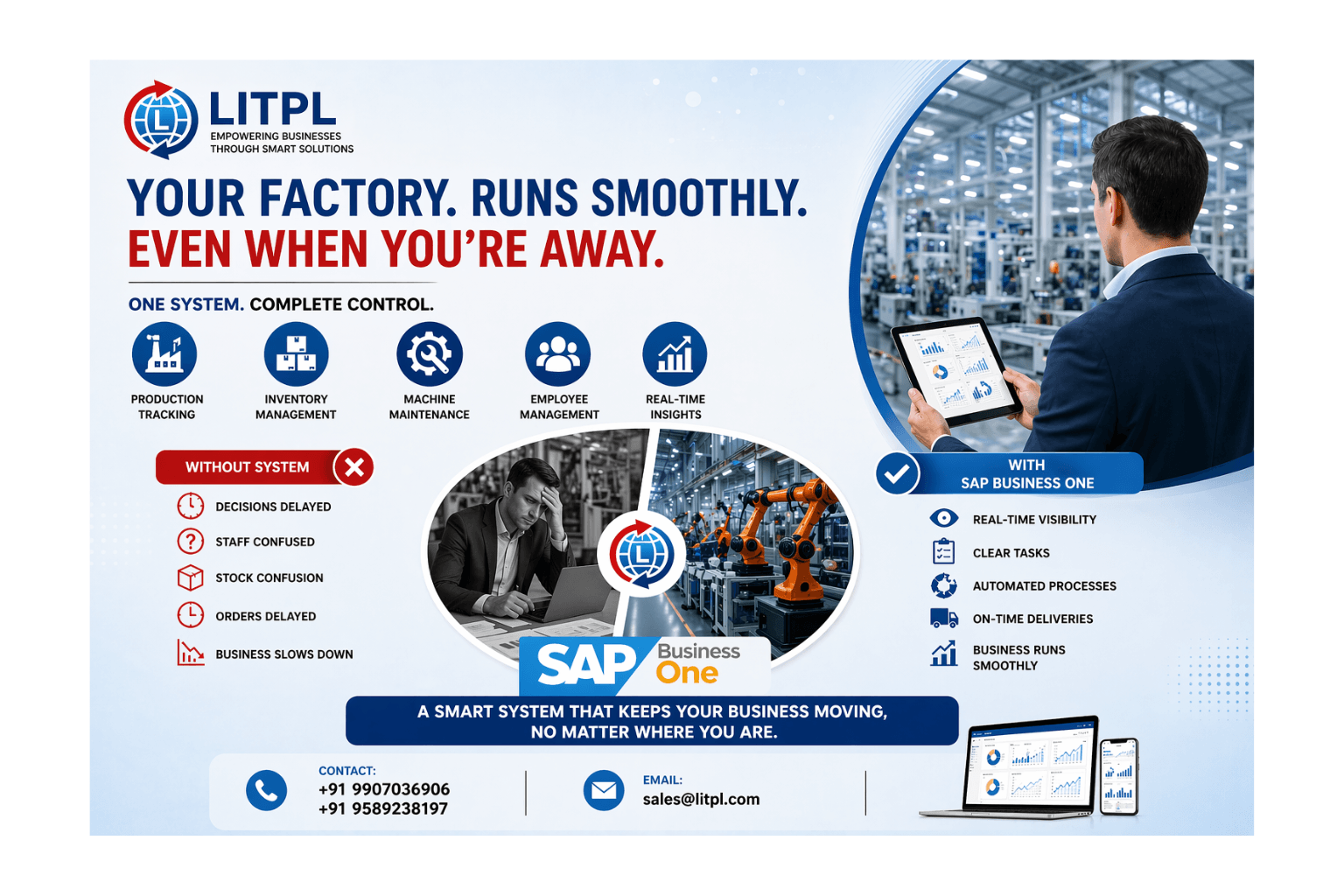
In many manufacturing companies, the entire operation depends heavily on the owner. From production planning to material purchase, stock checking, and dispatch approvals — everything is controlled or finalized by one person.
This creates a serious problem: when the owner is not available, the business slows down or even gets stuck.
Let’s understand this with a real-life situation and how a system like SAP Business One solves it.
Real-Life Problem in Manufacturing
Imagine a small manufacturing factory that produces plastic items.
Everything was running smoothly, but there was one issue — the manager was involved in every small decision.
One day, the owner had to go out of town for 3–4 days due to personal work.
During that time:
- Production planning got delayed because workers were waiting for approval
- Raw material purchase was stuck because no one was authorized to approve orders
- Inventory confusion happened — staff didn’t know exact stock levels
- Delivery schedules started getting delayed
- Minor machine issues were ignored or reported late
As a result, the entire factory slowed down.
Not because of a lack of workers or machines — but because the system depended on one person.
The Core Issue: Dependency on the manager
This is a very common problem in manufacturing businesses:
- Too much manual decision-making
- No centralized system
- No real-time data visibility
- Communication gaps between departments
So even a short absence of the owner creates confusion and delays.
The Solution: A Smart Manufacturing System
To solve this issue, the company implemented SAP Business One — an integrated ERP system designed for business management.
Instead of depending on individuals, the company shifted to a system-driven process.
How SAP Business One Solved the Problem
1. Real-Time Production Control
All production activities were visible in one dashboard. Workers and supervisors knew exactly what to do without waiting for instructions.
2. Automated Inventory Tracking
Stock levels were updated automatically. The system showed when raw materials were low and when to reorder.
3. Approval Workflow System
Purchase and operational approvals were structured digitally. No delays due to owner absence.
4. Clear Task Allocation
Every employee had assigned tasks in the system, reducing confusion and dependency.
5. Remote Monitoring
The owner could check production, inventory, and orders from anywhere using mobile or laptop.
The Result
After implementing the system:
- Production continued smoothly even when the owner was away
- No confusion among staff
- Orders were completed on time
- Efficiency improved significantly
The factory transformed from person-dependent to system-driven.
Conclusion
When a manufacturing business depends only on the owner, even a small absence can create big disruptions.
But with a smart system like SAP Business One, the entire operation becomes structured, automated, and independent.
This is how modern manufacturing companies move from “manual control” to “smart business management.”